Table of Contents
The Pest That Refuses to Leave
If you have ever tried to get rid of German cockroaches on your own, you already know the frustration. You spray, you clean, you set traps — and within days, they are back. It feels like fighting an enemy that adapts faster than you can act, and that is not far from the truth.
German cockroaches (Blattella germanica) are not the same as the large Australian cockroaches you might see scuttling across your patio at night. They are smaller, lighter in colour, and far more dangerous to your health and far more difficult to eliminate. Across Sydney’s Inner West and greater metro area, they are the single most common pest complaint that professional exterminators deal with, and for good reason.
In this guide, we explain exactly why German cockroaches are so resilient, why most DIY methods fail, and what professional pest control technicians do differently to achieve lasting elimination.
What Makes German Cockroaches Different from Other Cockroach Species?
Sydney is home to several cockroach species, including the Australian cockroach, the American cockroach, and the smoky brown cockroach. These are the large, dark-coloured roaches you typically find outdoors, in garden beds, under bark, or occasionally wandering into your kitchen through an open door.
German cockroaches are a completely different challenge. Here is what sets them apart:
They Live Exclusively Indoors
Unlike their larger cousins, German cockroaches do not survive well outdoors in Australia’s climate. They are entirely dependent on human habitation for warmth, moisture, and food. This means once they are inside your home, they are not going to leave voluntarily. Your kitchen, bathroom, and laundry are their ideal habitat.
They Reproduce at Staggering Rates
A single female German cockroach produces an egg case (called an ootheca) containing 30 to 40 eggs, and she can produce a new one roughly every six weeks. Within a year, a single breeding pair can theoretically generate tens of thousands of offspring. By the time you notice a few roaches in your kitchen, the colony behind your walls and under your appliances can already number in the hundreds.
They Develop Resistance to Consumer Pesticides
This is the factor that makes them truly formidable. German cockroach populations across Sydney have developed documented resistance to many of the active ingredients found in supermarket sprays and hardware store products. Pyrethroid-based sprays, which are the most common over-the-counter option, are increasingly ineffective against established colonies. The cockroaches that survive exposure pass their resistance genes to the next generation, making each successive attempt less effective.
They Are Cryptic and Nocturnal
German cockroaches are thigmotactic, meaning they prefer to squeeze into tight crevices where their bodies are in contact with surfaces on multiple sides. During daylight hours, they hide inside wall cavities, behind refrigerator motors, inside dishwasher doors, within electrical outlets, and in the gaps around plumbing penetrations. You rarely see the full extent of an infestation because the vast majority of the population remains hidden.
Why DIY German Cockroach Treatments Fail in Sydney Homes
Every week, our technicians at On Call Pest Control attend properties across Sydney’s Inner West and broader metro area where homeowners have spent months and hundreds of dollars on supermarket sprays, baits, and home remedies before calling a professional. Here is why those approaches rarely work:
Surface Sprays Push Roaches Deeper
Pyrethroid sprays create a repellent barrier on treated surfaces. When German cockroaches detect this, they do not die — they simply avoid the treated area and relocate deeper into wall cavities, under appliances, or into adjacent rooms. You have not eliminated the colony; you have scattered it, often making the problem worse and harder to treat professionally.
Supermarket Baits Are Insufficient for Established Colonies
Store-bought bait stations contain small amounts of active ingredient and are designed for light infestations. A German cockroach colony numbering in the hundreds or thousands will quickly exhaust these baits without meaningful population reduction. Professional-grade gel baits contain higher concentrations of active ingredients and are strategically placed in multiple harbourage points that consumer products cannot reach.
Bombs and Foggers Create Chemical Resistance
Total-release foggers (bug bombs) are perhaps the worst option for German cockroaches. The aerosol particles rarely penetrate into the cracks and crevices where roaches harbour. Instead, they deposit a thin layer of pesticide on exposed surfaces, giving the cockroaches a sub-lethal dose that accelerates resistance development. Pest control researchers have consistently shown that fogging increases pyrethroid resistance in German cockroach populations.
Home Remedies Are Myths
Bay leaves, cucumber peels, essential oils, and ultrasonic repellers have zero scientific evidence supporting their effectiveness against German cockroaches. While some of these may have a mild repellent effect on individual roaches, none address the underlying colony. Meanwhile, the population continues to grow.
The Health Risks: Why German Cockroach Control Is Urgent
German cockroach infestations are not simply a nuisance — they represent a genuine public health concern, particularly in households with children, elderly residents, or anyone with respiratory conditions.
German cockroaches are documented carriers of over 30 bacterial species, including Salmonella, E. coli, and Staphylococcus. They contaminate food preparation surfaces, utensils, and stored food with their faeces, saliva, and shed body parts. In a busy Sydney kitchen, this creates ongoing exposure to pathogens every time you prepare a meal.
Perhaps more significantly, German cockroach allergens are a major trigger for asthma and allergic reactions. Studies have shown that cockroach allergen exposure in early childhood is a significant risk factor for developing asthma. In the densely populated Inner West suburbs like Ashfield, Dulwich Hill, Camperdown, and Balmain, where older housing stock and apartment living create ideal conditions for cockroach harbourage, this is a serious concern for young families.
How Professional German Cockroach Control Works
At On Call Pest Control, our approach to German cockroach elimination is built on methods that target the entire colony lifecycle, not just the visible roaches. Here is what a professional treatment involves:
Step 1: Thorough Inspection and Colony Assessment
Our technician begins with a detailed inspection of every potential harbourage point in your property. This includes pulling out appliances, inspecting under sinks, checking electrical outlet covers, examining the seals around plumbing penetrations, and assessing wall cavities. We use flushing agents in targeted areas to estimate colony density and identify the primary harbourage sites.
Step 2: Professional-Grade Gel Bait Application
The backbone of effective German cockroach control is professional gel bait technology. Unlike consumer products, professional-grade baits use active ingredients that cockroaches have not yet developed widespread resistance to. The gel is applied in precise micro-dots at dozens of harbourage points throughout your kitchen, bathroom, and laundry. Cockroaches feed on the bait, return to the colony, and the active ingredient is transferred to other roaches through contact and coprophagy (faecal feeding), creating a cascading kill effect throughout the population.
Step 3: Insect Growth Regulators (IGRs)
IGRs are a critical component that many DIY treatments miss entirely. These compounds mimic cockroach hormones and prevent immature nymphs from developing into reproductive adults. Even if some adult roaches survive the initial treatment, IGRs ensure that the next generation cannot reproduce, breaking the breeding cycle and preventing colony recovery.
Step 4: Harbourage Reduction Advice
Our technician will provide specific recommendations for reducing conditions that support cockroach populations. This includes fixing leaking taps, sealing gaps around plumbing, reducing clutter in kitchen cupboards, and improving food storage practices. These changes make your property less hospitable and improve the long-term effectiveness of the treatment.
Step 5: Follow-Up Treatment and Monitoring
German cockroach control is rarely a one-visit solution for established infestations. We schedule follow-up treatments to target any surviving nymphs that hatch from egg cases after the initial treatment (egg cases are resistant to most insecticides). This systematic approach ensures complete colony elimination rather than temporary suppression.
German Cockroach Hotspots Across Sydney
Certain property types and locations across Sydney are more vulnerable to German cockroach infestations:
- Apartment buildings and unit blocks are the highest-risk property type. German cockroaches travel between units through shared wall cavities, plumbing risers, and electrical conduits. Treating a single unit without addressing neighbouring units often results in rapid reinfestation. Across the Inner West, older apartment blocks in suburbs like Ashfield, Burwood, Croydon, and Five Dock are particularly susceptible.
- Terraces and semi-detached homes in suburbs like Annandale, Balmain, Glebe, and Camperdown share walls and sometimes plumbing with neighbouring properties, creating similar pathways for cockroach movement between dwellings.
- Commercial kitchens and food preparation areas in restaurants, cafes, and takeaway shops provide ideal conditions for German cockroach colonies, with abundant food, moisture, and warmth. Regular professional pest management is essential for food businesses to maintain compliance with NSW Food Authority requirements.
How to Know If You Have German Cockroaches
Identifying the species correctly is important because treatment approaches differ significantly. Here are the key signs of a German cockroach infestation:
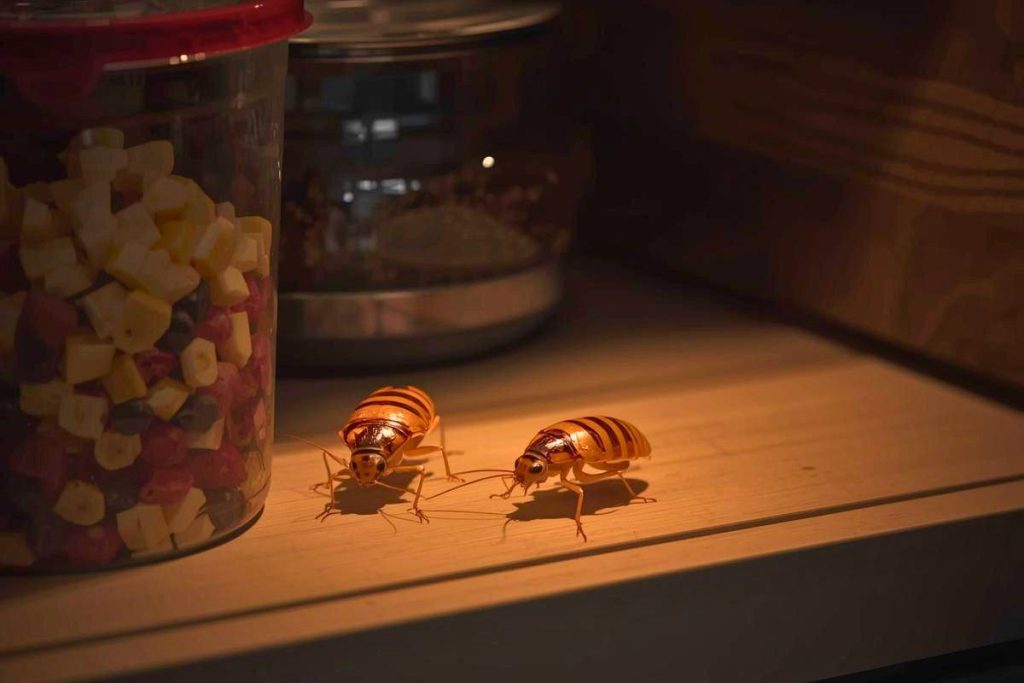
- Size and colour: German cockroaches are 12 to 15 millimetres long, tan to light brown, with two distinctive dark parallel stripes running from behind the head to the base of the wings. Australian and American cockroaches are 30 to 50 millimetres long and dark brown to reddish-brown.
- Location: If you are finding small cockroaches inside your kitchen, bathroom, or laundry — particularly near appliances, under sinks, or around plumbing — they are almost certainly German cockroaches. Large cockroaches found near external doors, in garages, or in garden areas are typically Australian or American species.
- Droppings: German cockroach droppings appear as small dark specks or smears, often found in kitchen drawers, along benchtop edges, inside cupboard hinges, and around the seals of refrigerator doors. A musty, oily odour in the kitchen is another indicator of a significant infestation.
- Activity timing: Seeing cockroaches during daylight hours typically indicates a severe infestation. German cockroaches are nocturnal, and daytime sightings mean the harbourage sites are overcrowded, forcing individuals out into the open.
German Cockroach FAQs
How long does professional German cockroach treatment take to work?
Is professional cockroach treatment safe for children and pets?
Why do German cockroaches keep coming back after treatment?
How much does German cockroach treatment cost in Sydney?
On Call Pest Control offers German cockroach treatment starting from $89 for standard residential properties across Sydney. The final cost depends on the severity of the infestation and the size of the property. We provide upfront pricing with no hidden fees.
Protect Your Sydney Home Today
German cockroaches are not a pest you can afford to ignore or attempt to manage with DIY methods. Every week of delay allows the colony to grow, spread, and become more resistant to treatment. If you are seeing small, light-brown cockroaches in your kitchen or bathroom, act now.
On Call Pest Control provides expert German cockroach extermination across Sydney’s Inner West and all metro suburbs. Our licensed technicians use the latest professional-grade treatments to eliminate infestations at the source.
Call 0426 511 911 or visit oncallpestcontrol.com.au to book your treatment today. Prices start from $89.